Blog
BJJ, Judo, Karate and Taekwondo Uniforms: What Is the Difference?

A BJJ gi uses a light but strong pearl weave jacket for grappling. A judogi uses a heavier single or double weave jacket with a stiff collar for gripping and throws. A karate gi is a looser cotton twill or canvas cut for kicks and stances, and a taekwondo dobok is a light poly-cotton V-neck built for speed.
The four uniforms side by side
| BJJ gi | Judo uniform | Karate gi | Taekwondo dobok | |
|---|---|---|---|---|
| Typical jacket fabric | Cotton pearl weave | Cotton single or double weave | Cotton twill or poly-cotton canvas | Poly-cotton, ribbed or diamond weave |
| Typical weight | 350 to 450 GSM | 450 to 750 GSM | 6 oz to 14 oz | Light |
| Jacket style | Wrap front, fitted | Wrap front, thick collar | Wrap front, loose | V-neck pullover or wrap front |
| Cut | Fitted sleeves and legs | Wider, to standard lengths | Loose for kicks and stances | Loose and light |
| Sizes | A0 to A5, kids | 000 to 7 | 000 to 7 | 000 to 7 |
| Competition colours | White, royal blue, black (IBJJF) | White and blue (IJF) | White in most styles | White, with rank collar |
These are the ranges QST works in. Other makers may use different weights.
Brazilian jiu-jitsu gi
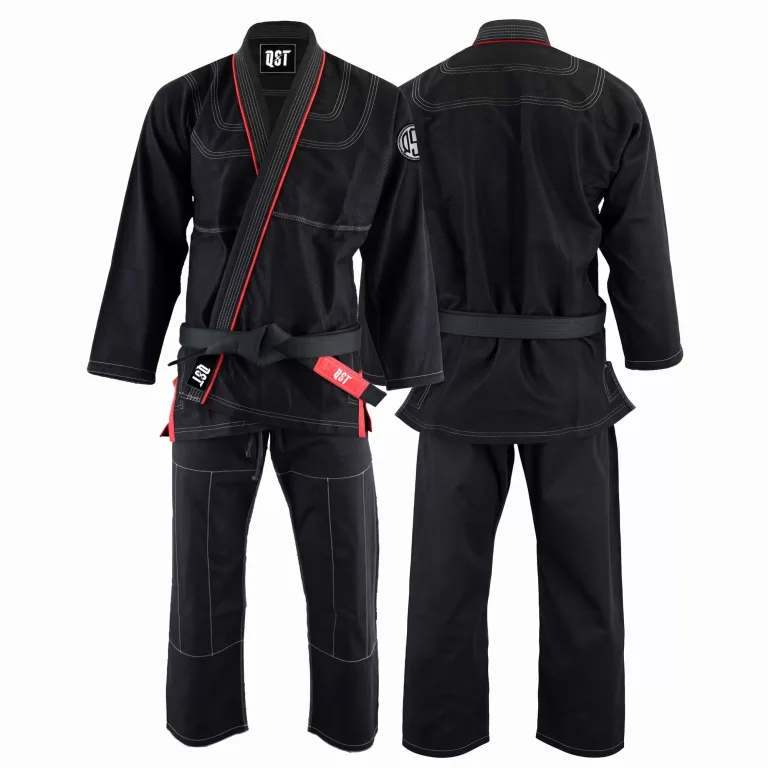
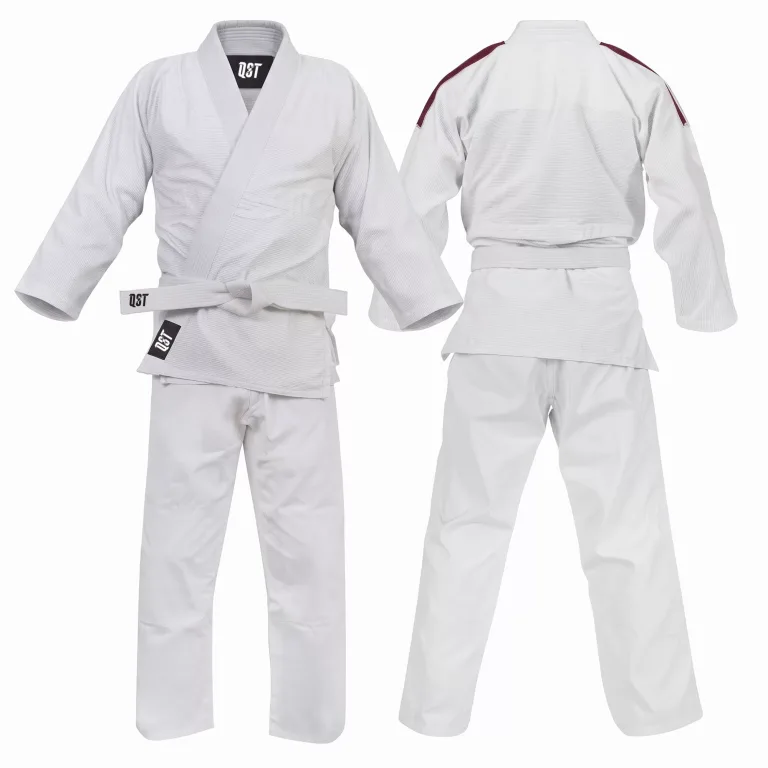
A BJJ gi has to survive grips, pulls and rolling on the ground. The pearl weave jacket is strong for its weight, the collar is padded, and the pants are cotton twill or ripstop with reinforced knees. IBJJF competition allows white, royal blue or black gis, with the jacket and pants in the same colour. See QST’s Brazilian jiu-jitsu gis.
Judo uniform
A judogi is the heaviest of the four. Single weave jackets are lighter for daily training, and double weave jackets are thicker and harder to grip, which suits competition. In IJF competition one athlete wears white and the other blue, and IJF events require a judogi with an official IJF label. See QST’s judo uniforms.
Karate gi
A karate gi is cut loose so the hips and shoulders move freely. Light gis of about 6 to 8 oz suit beginners and kumite, and heavy canvas of 12 to 14 oz holds its shape and snaps in kata. See QST’s karate uniforms.
Taekwondo dobok
A dobok is the lightest uniform, made in a breathable poly-cotton blend for high, fast kicks. World Taekwondo doboks usually have a V-neck pullover jacket, and in most clubs the collar colour shows rank. See QST’s taekwondo uniforms.
Can one uniform do everything?
Not well. A karate gi is too loose and too light for judo throws, and a judogi is too heavy for taekwondo kicking. Clubs that teach several arts usually stock one uniform per art, in the club’s colours and logo.
Who makes these uniforms
QST International makes martial arts uniforms, belts and protective gear to order in Sialkot, Pakistan. The facility is WRAP certified and certified to ISO 9001, ISO 14001 and ISO 45001, and it shares its ethical audit data with buyers through Sedex. The minimum order is 30 to 50 sets, pairs or pieces per design, a sample takes 7 to 10 days, and bulk production takes 4 to 6 weeks after approval. Ask for a quote.
Frequently asked questions
What is the difference between a BJJ gi and a judo gi?
A BJJ gi is lighter and more fitted, usually pearl weave at 350 to 450 GSM. A judogi is heavier, 450 to 750 GSM, with a thicker collar and a wider cut.
Can I use a judo gi for BJJ?
Many people do for training, but a judogi is heavier and looser. IBJJF competition has its own gi rules, so check them before a tournament.
What weight karate gi should I buy?
Light gis of about 6 to 8 oz suit beginners and kumite. Heavy canvas of 12 to 14 oz suits kata and senior grades.
What does the dobok collar colour mean?
In most World Taekwondo clubs, white collars are for coloured belts, red and black collars for junior poom holders and black collars for dan holders.